Who Should Review Auction Catalog Drafts Before Publication?
Give photographers, cataloguers, specialists, and final approvers distinct review responsibilities so you can resolve questions and publish from one agreed catalog.

If you’re deciding who should review auction catalog descriptions, divide the work among the people best placed to check it: photographers verify visual coverage, cataloguers check the written record, specialists examine higher-risk claims, and a named final approver authorizes publication. In a small auction house, one person may fill several roles, but each review should remain a separate task.
The goal is not to have everyone rewrite every lot. It is to give each reviewer a defined question to answer and a clear way to return corrections.
AuctionWriter’s AI cataloging software turns lot photos into draft titles, descriptions, and estimates, organizes photos into lots, and exports catalogs to supported auction platforms. Your review process sits around that drafting work. The responsibilities below are operating practices you establish, not a description of built-in assignments, permissions, approval queues, or audit logs.
How should you separate photo capture, drafting, and final review responsibilities?
Start by separating what each person can reliably verify. A photographer handling the object can check details that a cataloguer working from images may not be able to establish. A final approver should check whether the catalog is ready to publish rather than repeat every drafting decision.
Use this division of responsibility:
| Role | Main review responsibility | What to flag |
|---|---|---|
| Photographer | Confirm that the images match the lot and show the necessary details | Missing views, unreadable marks, hidden damage, incorrect grouping |
| Cataloguer | Check that the title, description, and lot contents agree | Unsupported wording, inconsistent quantities, missing measurements, ambiguous identification |
| Specialist | Assess questions that require category knowledge or additional evidence | Attribution, materials, age, originality, provenance wording, estimate concerns |
| Final approver | Confirm that outstanding questions are resolved and the catalog is ready | Unresolved notes, mismatched images, inconsistent wording, export problems |
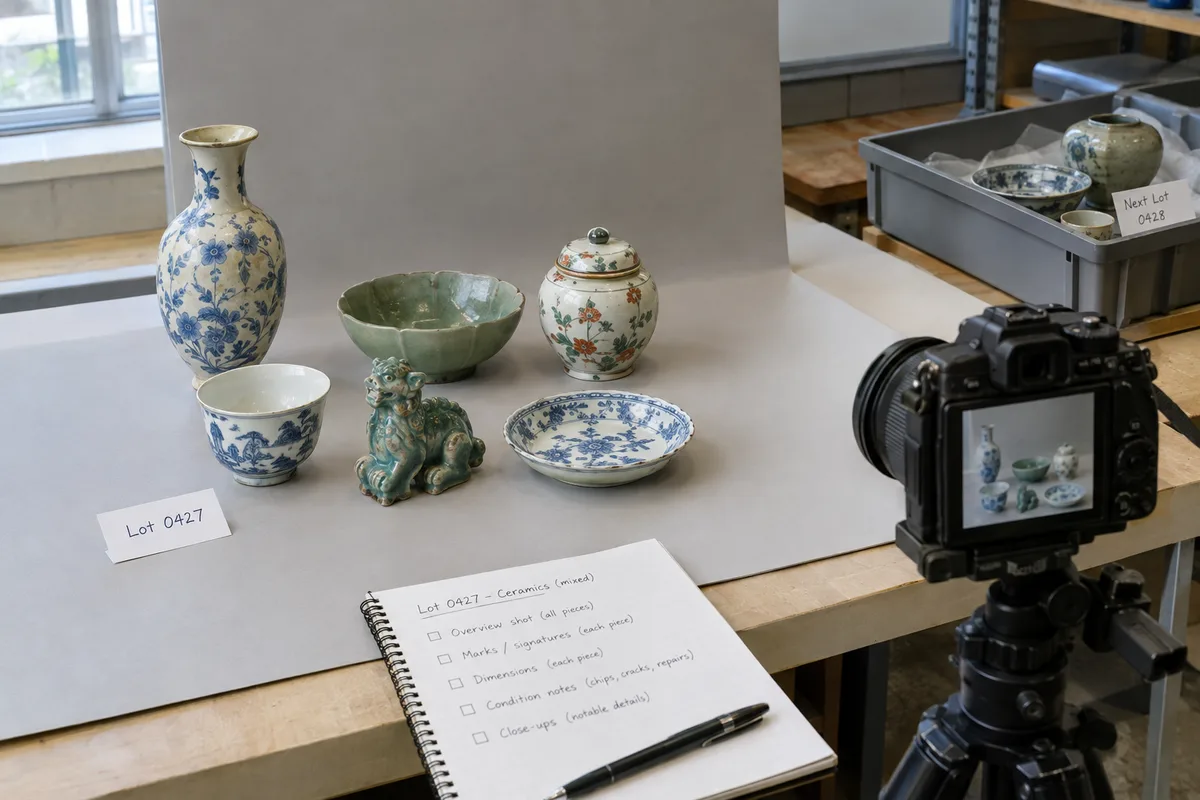
Give the photographer a capture checklist before drafting begins. Depending on the object, it might call for an overall view, reverse, underside, maker’s mark, accessories, and close-ups of visible defects. Agree on a photo-management process that keeps those images connected to the correct lot.
The cataloguer should then compare the draft with the images and any physical inspection notes. Treat a fluent description as a starting point, not evidence that every detail is correct.
If you work alone, perform these checks in separate passes. First check images and lot contents, then language and evidence, and finally publication readiness. Avoid trying to inspect everything while also writing.
Which higher-risk lots should receive specialist checks?
Send a lot for specialist review when the proposed wording goes beyond what your cataloguer can support confidently. An unfamiliar maker’s mark, uncertain material, or unclear signature is a reason to pause, not an invitation to make the description sound more definite.
Useful triggers include:
- A named maker, artist, designer, or manufacturer whose identification is uncertain.
- An age, origin, material, or originality claim that depends on interpretation.
- A signature, edition number, hallmark, or label that is incomplete or difficult to read.
- Provenance information that needs to be checked against supplied records.
- Condition questions that the available photographs do not resolve.
- A draft estimate that needs review by someone familiar with the category.
Give the specialist a specific question. “Please review this lot” is less useful than “Does the photographed mark support naming this maker in the title?” Include the relevant photographs, measurements, inspection notes, and supporting documents.
Ask for an actionable response: approved wording, revised wording, a request for more evidence, or a recommendation to hold the lot. If specialist review is unavailable, narrow the description to what you can support or delay publication rather than quietly treating the question as resolved.
Keep specialist attention focused on the lots that need it. Routine checks for spelling, quantity, and image order should remain with the cataloguer.
What shared standard should you use for uncertain claims?
Create a short house style guide that tells reviewers how to distinguish observation from interpretation. Without that standard, one cataloguer may describe a visible mark while another turns the same mark into a firm attribution.
For each disputed statement, ask three questions:
- What can you observe? Record visible features, measurements, inscriptions, quantities, and condition details precisely.
- What supports the interpretation? Identify the inspection, document, or specialist input behind the proposed wording.
- What remains unresolved? Decide whether to obtain more information, qualify the statement, remove it, or hold the lot.
For example, “underside bears a stamped mark reading ‘ABC’” reports an observation. Naming ABC as the manufacturer adds an interpretation that needs support. Likewise, photograph a signature clearly before deciding how to describe the object’s authorship.
Do not use qualifying language simply to preserve an otherwise unsupported claim. Words such as “possibly,” “attributed to,” and “style of” need a consistent house standard and appropriate review; they should not become interchangeable substitutes for “we have not checked.”
Apply the same discipline to condition. Describe the defect you can identify rather than letting a broad phrase such as “good condition” replace specific information. Where your images or inspection are incomplete, request the missing check.
A draft estimate also needs an explicit review decision. Do not let it pass through merely because it appeared alongside an otherwise acceptable description.
How can you handle corrections without creating conflicting drafts?
Choose one working catalog as your source of truth. Reviewers can use a shared correction sheet or another agreed communication method, but they should not maintain separate, competing versions of the full catalog.
Record each requested change against a stable lot identifier. A useful correction entry contains:
- The lot number or internal identifier.
- The field or image that needs attention.
- The exact issue and proposed correction.
- The person responsible for resolving it.
- Whether the change is still open or has been checked.
These are process records you maintain; they do not depend on AuctionWriter providing a task or approval system.
For example, replace “fix vase description” with “Lot 142: remove the maker name from the title pending review of the underside mark.” That gives the cataloguer a clear action and tells the final approver what remains unresolved.
Nominate one person to incorporate changes into the working catalog. Other reviewers should return corrections through the agreed channel rather than editing downloaded copies and sending them back without context.
Your catalog-management process should also define what happens after the review cutoff. If a late correction changes identification, lot contents, images, or an estimate, return the affected lot for the relevant check. Then update the working catalog and replace any outdated export instead of patching several versions independently.
Who should give final approval before catalog export?
Name the final approver before review begins. Choose someone who understands your house standards and can decide whether to publish, revise, or hold a lot. Avoid making approval the default responsibility of whoever happens to perform the export.
Before authorizing the catalog, the approver should confirm that:
- Lot identifiers, titles, descriptions, and photographs agree.
- Quantities, measurements, and included accessories have been checked where relevant.
- Specialist questions have clear outcomes reflected in the text.
- Draft estimates have received the required review.
- Internal notes, placeholders, and unresolved questions are removed or resolved.
- Any held lots are excluded from the publication version.
Then inspect the exported output. Check image order, text formatting, lot numbering, and the fields required by your destination platform. If you import the catalog into a platform preview, inspect that version before publication as well.
AuctionWriter sits in front of your auction systems: it prepares catalog content for export rather than running the live sale, registering bidders, or settling invoices. Keep approval responsibility explicit across that handoff.
Once the approver signs off through your agreed operating process, retain a clearly identified final copy. If anything changes afterward, recheck the affected content and replace the publication version deliberately. Final approval should identify which catalog is approved, not merely that someone reviewed an earlier draft.