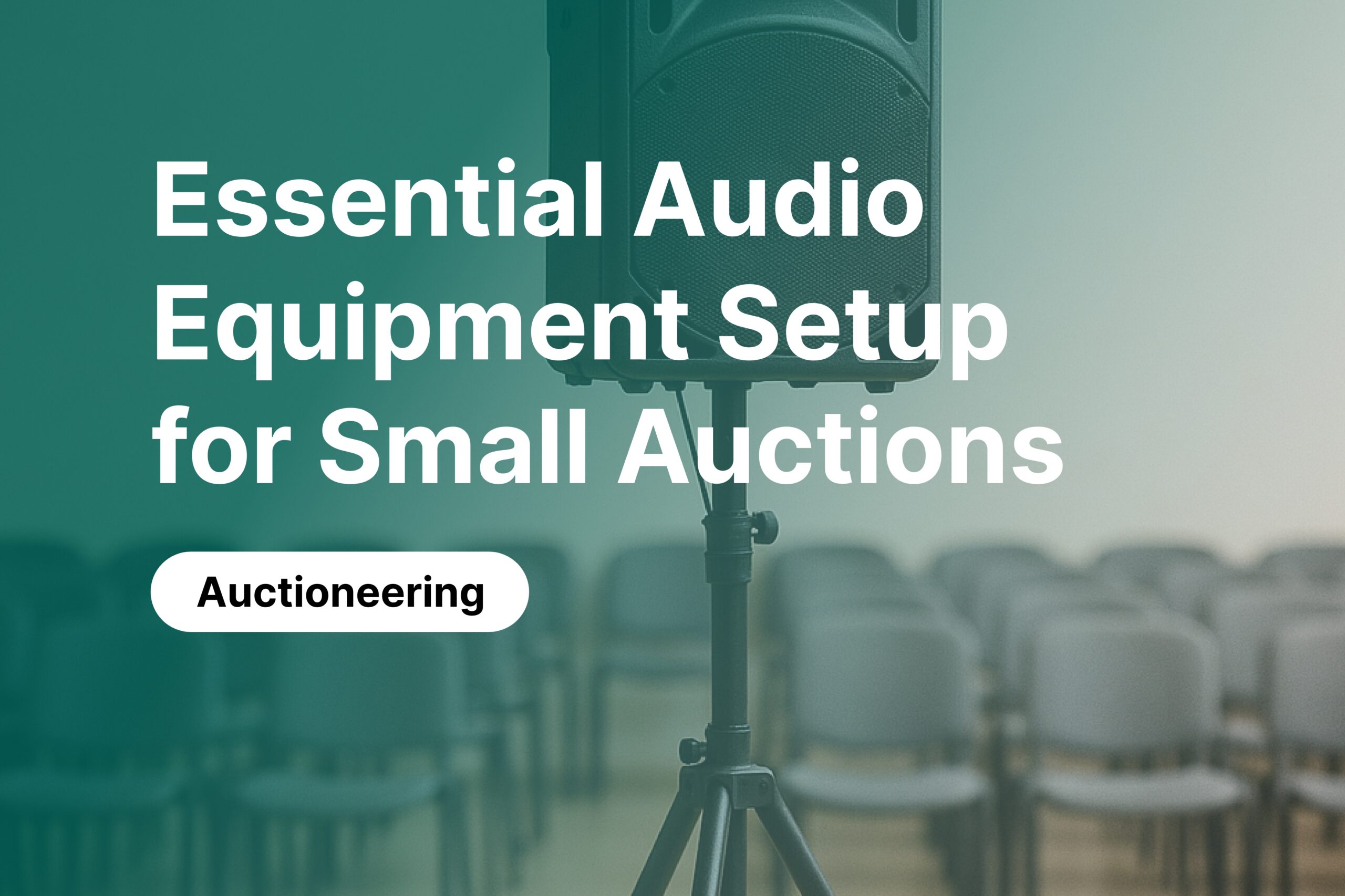
The Essential Audio Equipment Setup for Small-Venue Auctions
In a small-venue auction, your sound system is either your best salesperson or your worst enemy. Whether you’re in a hotel ballroom, a church gym, a community hall, or a drafty barn, one rule drives how much money you make: Every word must be heard. This guide distills current best practices, gear options, placement rules, […]
In a small-venue auction, your sound system is either your best salesperson or your worst enemy. Whether you’re in a hotel ballroom, a church gym, a community hall, or a drafty barn, one rule drives how much money you make:
Every word must be heard.
This guide distills current best practices, gear options, placement rules, and quick-fix workflows into a single, practical playbook. The goal: deliver 65–75 dB-A of clear, intelligible speech at the back row for 40–200 bidders in a 1,500–5,000 ft² room—without overspending or overcomplicating your rig.
Understanding the Acoustic Realities of Small-Venue Auctions
Before buying gear, you need to understand what the room is doing to your sound.
- SPL target: Aim for 65–75 dB-A at the back row—about normal-to-loud conversation. Loud enough to cut through chatter, but not fatiguing.
- Reverberation (RT60): Gyms, barns, and church halls often have 0.8–1.6 seconds of reverb. That echo smears consonants and makes the auctioneer’s chant muddy unless you use directional mics and tightly aimed speakers.
- Crowd noise spikes: When bidding heats up, crowd noise can jump by 6–10 dB. Your system should have at least +10 dB of headroom so you’re not flirting with distortion during the most important moments.
- Coverage footprint: A typical PA horn pattern of 90° (horizontal) × 60° (vertical) means two well-placed speakers can comfortably cover a 50 × 70 ft floor.
Acoustics experts often use the Speech Transmission Index (STI) to quantify intelligibility. As Dr. Kevin Donohue of the University of Kentucky notes, keeping STI above 0.6 roughly corresponds to maintaining a 65–70 dB direct-to-reverb ratio in small halls—exactly what you’re aiming for.
Core Equipment Categories: What Matters and Why
An effective auction audio system has four pillars: microphones, mixers, speakers, and accessories. Get these right and everything else becomes easier.
1. Microphones – Voice Is King
Your microphone choice has more impact on intelligibility and feedback control than almost any other decision. For auctions, you want cardioid (directional) mics that focus on the auctioneer and reject the room.
- Handheld dynamic (wired)
- Best for: Primary or backup mic on any budget
- Strengths: Rugged, excellent feedback rejection, simple to operate
- Examples: Shure SM58, Sennheiser e835
- Street price: ~$99–120
- Why it works: A 2022 Shure Pro Audio survey found cardioid handheld dynamics reduce auction-hall feedback incidents by about 40% compared to omnidirectional lavaliers.
- Wireless handheld (UHF / 2.4 GHz digital)
- Best for: Auctioneers who roam the room or stage
- Strengths: Mobility, no long mic cable to trip over
- Examples: Audio-Technica ATW-1102, Sennheiser XSW-D
- Street price: ~$299–399
- Tip: Choose systems with diversity receivers to reduce dropouts.
- Headset / headworn condenser
- Best for: Fast-talking auctioneers who need both hands free
- Strengths: Mic stays at a constant distance from the mouth; very consistent level and clarity
- Examples: Countryman E6 with compatible wireless (e.g., Sennheiser EW-D, AT System 10), Samson HS5 bundles
- Street price: ~$199–499 (often including transmitter/receiver)
- Gooseneck podium mic
- Best for: Fixed podium auctions and clerking desks
- Example: Shure MX412 (~$199)
- Note: Use a shock-mounted podium to avoid thumps and bumps.
Best practice: Always have at least two mics ready:
- One primary mic (wireless handheld or headset)
- One spare wired handheld (e.g., SM58) permanently plugged in as a fail-safe
If you live-stream or record, you can add a third, ambient mic aimed at the crowd, routed only to the recording—not the PA.
2. Mixers & Signal Management – The Control Center
Your mixer balances sources, shapes tone, and feeds speakers and recorders. For auctions, you want simple, reliable, and repeatable more than flashy features.
- Channel count: 4–8 channels is usually enough:
- Auctioneer mic
- Spare mic / ringman
- Music or timer audio
- Optional ambient or record feed
- On-board EQ: At least a 3-band EQ with a sweepable mid so you can:
- Cut 300–400 Hz “boxiness”
- Add a gentle boost around 4 kHz for clarity
- Feedback control: Semi-parametric mids or an external feedback suppressor are very helpful in reflective rooms.
- Outputs: Balanced XLR main outs to powered speakers plus at least one aux/monitor out for recording or streaming.
Solid budget–midrange mixer picks (2024):
- Behringer Xenyx Q802USB (~$99) – Compact, inexpensive, with USB record out.
- Mackie Mix8 (~$99) – Very robust, no built-in effects, excellent for speech-only use.
- Yamaha MG06X (~$149) – High-quality preamps, XLR outs, and SPX effects (useful if you also run music or announcements).
- Allen & Heath ZED-10 (~$299) – Industry workhorse with flexible inputs and great sound.
3. Amplification & Speakers – Where Power Meets Coverage
For small auctions, powered (active) PA speakers are the standard. They combine amp and speaker in one box, which:
- Removes a separate amp rack (one less failure point)
- Simplifies cabling and setup
- Makes the system easier to transport and scale
| Audience Size | Recommended Driver | Example Models | Approx. Price (each) |
|---|---|---|---|
| ≤ 80 people | 8″ powered cabinet | Behringer B208D, Alto TS308 | $229–299 |
| 80–150 people | 10″ 2-way | JBL EON710, EV ZLX-10P | $399–499 |
| 150–250 people | 12″ 2-way | QSC CP12, Yamaha DXR12mkII | $649–799 |
| Mobile minimalist | Column array system | Bose L1 Pro8, Turbosound iP2000 | $899–1,199 |
Rental data from AV Alliance (2023) shows powered 10″ speakers are booked about 3:1 over passive rigs for events under 300 people, largely because they’re simpler and more reliable for non-technical users.
For most small auctions, a pair of 10″ powered speakers on stands is the sweet spot: light enough to carry, loud enough for 150 people, and very clear for speech.
4. Essential Accessories That Save the Day
Small, inexpensive items often determine whether your event feels professional or chaotic.
- Speaker stands: Sturdy, preferably air-cushioned, to get the horns up to 6–7 ft above the floor.
- XLR cables: 25–50 ft, balanced, with a few spares. Color-coding simplifies setup and troubleshooting.
- Power distribution: Surge-protected power strips and 14-gauge extension cords rated for 15 A.
- Batteries: Extra AA/9 V or rechargeable lithium packs for wireless systems (start every auction with fresh or fully charged packs).
- Gaffer tape: For securing cables across walkways. Unlike duct tape, gaffer tape is code-friendly in most venues and doesn’t leave residue.
System Design, Wiring & Placement Tactics
Clean, Repeatable Signal Chain
Keep your wiring simple and consistent from event to event:
Handheld / Headset Mic → Mixer preamp → Mixer main output → Powered speakers
Wireless Mic → Wireless receiver (XLR out) → Mixer → Powered speakers
Example layout:
        [Auctioneer mic]
              │ XLR 25'
        ┌─────▼──────┐
        │   Mixer    │
        │  CH 1–4    │
        └─────┬──────┘
              │ XLR L/R 30'
    ┌─────────▼────────────┐        ┌─────────▼────────────┐
    │ Powered Speaker (L)  │        │ Powered Speaker (R)  │
    │ 10" @ 6.5 ft height  │        │ 10" @ 6.5 ft height  │
    └──────────────────────┘        └──────────────────────┘
Speaker Placement Rules That Prevent Problems
- Height: Audience ear height is roughly 4.5 ft. Place the speaker’s high-frequency horn so its center is at 6–7 ft to project over heads.
- Angle: “Toe in” each speaker about 15° toward the center aisle. This aims sound at people instead of walls and cuts down on reflections.
- Distance: Maintain clear line-of-sight. Don’t park speakers too far forward or backward:
- Keep the front row a few feet back from the speakers.
- Avoid placing speakers more than 25 ft from the front row, or the front will be blasted while the back struggles to hear.
- Feedback control: Never put speakers behind the microphone. Keep the mic at least 120° off-axis from the speaker to minimize feedback.
- Deep rooms & delay fills: If the room is deeper than 60 ft, add a small “delay” speaker (e.g., an 8″ powered cabinet) halfway back. As a rule of thumb, add about 1 ms of delay per extra foot beyond the front speakers (e.g., 40 ft from mains ≈ 35 ms of delay).
Three Proven System Recipes (With Realistic Budgets)
1. Entry Setup (< ~$800 Street) – 50–80 Bidders, Indoor
- Mic: Shure SM58 wired – ~$99
- Mixer: Behringer Xenyx Q802USB – ~$99
- Speakers: 2 × Alto TS308 8″ powered – ~$598 total
- Accessories: Stands, XLR cables, gaffer tape – ~$80
Approx. total: $876 (bundle deals can bring this closer to $800).
Ideal for small charity events, school fundraisers, and backup rigs.
2. Mid-Tier Setup (~$1,500) – 80–150 Bidders, Indoor / Tent
- Wireless handheld: Audio-Technica System 10 ATW-1102 – ~$349
- Wired spare: Shure SM58 – ~$99
- Mixer: Yamaha MG06X – ~$149
- Speakers: 2 × JBL EON710 10″ powered – ~$800 total
- Accessories: Cables, stands, plus a Behringer FBQ1000 feedback suppressor – ~$139
Approx. total: $1,536
A flexible, professional-feeling rig that handles typical hotel ballrooms and small outdoor tents with ease.
3. Pro Setup (~$3,000) – 150–250 Bidders, Multi-Site & Rentals
- Headset system: Countryman E6 + Sennheiser EW-D Digital – ~$799
- Spare wireless handheld: Sennheiser EW-D – ~$699
- Mixer: Allen & Heath ZED-10 – ~$299
- Main speakers: 2 × QSC CP12 12″ powered – ~$1,398 total
- Delay/fill: 1 × QSC CP8 – ~$499
- Cases & cabling: ATA rolling case, extra XLR & power – ~$250
Approx. total: $2,944
Built for traveling auctioneers, rental operations, and high-value events where failure is not an option.
10-Minute Soundcheck & Operation Workflow
Once your gear is in place, run this quick routine before doors open:
- Inspect: Visually check all cables, connectors, and power strips for damage or loose fits.
- Power sequence:
- On: Mixer (and wireless receivers) first, then powered speakers.
- Off: Speakers first, then mixer. This protects your speakers from pops.
- Set mic gain: Have the auctioneer speak at full speed. Adjust the channel trim so peaks hit about -6 dB on the mixer meters—no red clip lights.
- Shape the EQ:
- Cut 3–4 dB around 315 Hz to reduce muddiness.
- Boost about 2 dB around 4 kHz to enhance consonants and clarity.
- Walk test: Have the auctioneer walk the main floor with the mic. Listen for:
- Coverage gaps
- Potential feedback spots
- Wireless dropouts (if applicable)
- Check the spare mic: Test your backup handheld on its own channel with a sensible gain setting.
- Test background music (if used): Keep music about 20 dB below the voice level and confirm it doesn’t mask announcements.
Common Tech Mishaps & Fast Field Fixes
Feedback “Howl”
- Lower the mic channel gain by 3 dB and/or the main fader slightly.
- Bring the mic closer to the mouth (within 2″) so you can run the system at a lower overall level.
- Use the mixer’s mid EQ to sweep and notch out the offending frequency.
- Angle speakers slightly away from the mic position; ensure they’re never behind the mic.
Hum or Buzz (60 Hz)
- Plug all audio gear into the same power circuit if possible.
- Use an isolating DI box with ground lift when interfacing with a venue’s house system.
- Engage the mixer’s ground-lift switch if available.
Wireless Dropouts
- Re-scan or change to a cleaner frequency/channel.
- Ensure receiver antennas have clear line-of-sight to the mic.
- Keep at least 10 ft between multiple wireless receivers and avoid stacking antennas.
- Always start with fresh batteries or fully charged packs.
Clipping & Distortion
- Watch the mixer meters and speaker “limit” lights.
- If you see red, reduce the mixer main fader first; if still clipping, back down the channel gain slightly.
Dead Mic
- Check power (switches, phantom power if needed), mute buttons, and cable connections.
- On wireless, swap batteries and confirm the transmitter–receiver pairing.
- Fail-safe: Keep a wired SM58 (or similar) permanently plugged in and taped to the podium. If wireless fails, grab it and keep selling.
Trends & Upgrades to Watch (2024–2027)
- Column array PA systems: Slim, portable systems (Bose L1 Pro8, Turbosound iP2000, LD Systems Maui series) with 120°×40° dispersion. They offer even coverage, fast setup, and are growing quickly in the rental market.
- App-controlled digital mixers: Mixers like the Behringer Flow 8 or Mackie DLZ Creator let an assistant walk the room with a phone or tablet and tweak EQ and levels on the fly.
- Rechargeable lithium wireless packs: Systems such as Shure SLX-D with SB903 batteries offer 8+ hours of runtime and reduce ongoing battery costs and waste.
- Dante / AES67 networked audio: As entry interfaces drop below ~$600, networked audio becomes realistic for multi-room auctions and live-stream integration without complex analog snakes.
Printable Auction Audio Checklist
Print and laminate this checklist; keep it in your audio case:
- □ Two working microphones (primary + wired backup)
- □ Fresh batteries or fully charged wireless packs
- □ Mixer powered, gains set, EQ dialed in (no red clip lights)
- □ Speakers on stands, horns at 6–7 ft, in front of mics, not behind
- □ All cables strain-relieved and taped with gaffer tape
- □ Spare XLR and IEC/power cables in the case
- □ Feedback suppressor configured and engaged (if you use one)
- □ Background music source tested and at safe level
- □ Power strips and extension cords rated for 15 A
- □ Contact number for on-call AV or tech support (if available)
Bringing It All Together
Successful small-venue auctions aren’t about owning the biggest, flashiest sound system. They’re about:
- Choosing the right directional mic and always having a backup
- Using a simple, reliable mixer with sensible EQ
- Deploying powered speakers on proper stands and aiming them correctly
- Following a repeatable wiring and soundcheck routine
- Knowing a handful of fast troubleshooting moves when things go sideways
With the equipment combinations and tactics in this guide, you can confidently cover up to 250 bidders, stay within comfortable OSHA listening levels, and work within realistic budgets—all while maintaining the agility to set up in under 20 minutes and keep the chant crystal clear from the first lot to the final hammer.